
Luxury rental community in Scottsdale to preserve Frank Lloyd Wright-inspired building
Ed Gorman knew he had a gem when he saw the opportunity to buy Vitalant's former Scottsdale headquarters.
The 10-acre parcel at 6200 E. Oak St. wasn't on the market, but in March, Gorman was able to negotiate a $9.25 million purchase of the property with SR zoning already in place that allows for commercial and residential development.
While the 70,000-square-foot former Vitalant office space will be razed to pave the way for 94 luxury rental units, one 4,500-square-foot building designed by architects linked to Frank Lloyd Wright will be preserved, said Gorman, founder of Modus Companies.
The building will be transformed into coworking space for residents, complete with conference rooms and smaller rooms for virtual meetings and podcasts, he said.
That building, which is at the entrance to the build-to-rent project, will have its own parking area so visitors meeting with residents can park separately without having to drive through the gated residential community, he said.
In 1971, Stephen Nemtin of Taliesin Associates Architects, affiliated with the Frank Lloyd Wright Foundation, worked with John Wesley Peters, who at the time was director of Taliesin Architects, to design the office building with amid-century modern architecture style. It was completed in 1972.
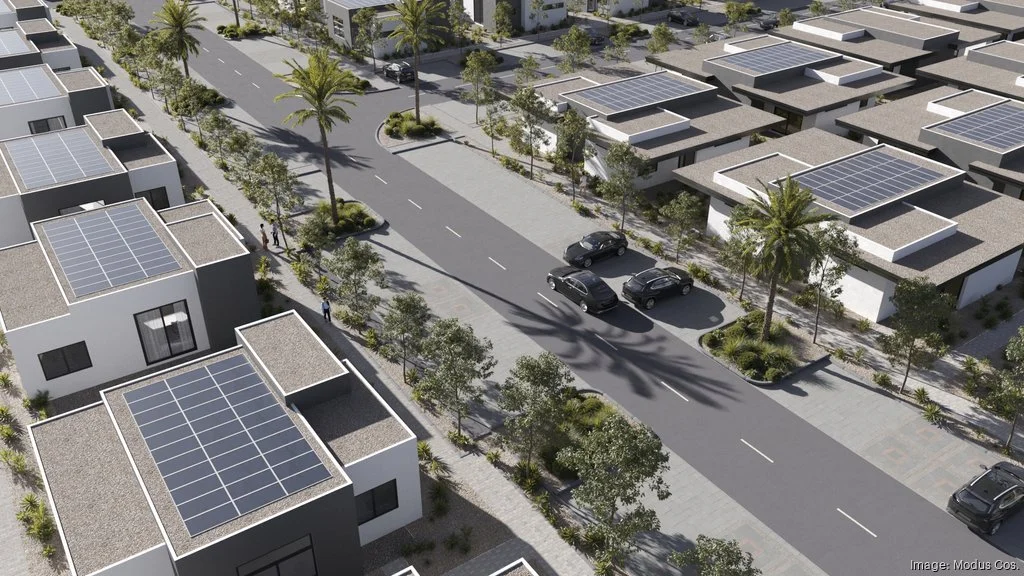
The entire residential community will maintain a midcentury modern architectural style and also will fi t comfortably within the surrounding neighborhood, he said.
He selected Scottsdale-based David Dick Architect Inc. to design the luxury rental community because founder David Dick is known for his mid-century modern architecture, Gorman said.
A general contractor has not yet been selected, Gorman said.
On the opposite end of the gated community, away from the entrance and co-working space will be a community clubhouse, pool and spa, fitness center, recreation area and dog park.
To be called Papago Village, the community is at the base of Papago Mountain and Papago Park, with the north end of the property offering unobstructed views of Camelback Mountain.
All homes will be single story, with 812-square-foot one-bedroom units and1,206-square-foot two-bedroom units. The primary bedrooms will be 12-by-14 feet, which is large for a typical BTR project, he said.
Gorman is projecting monthly rental rates to range between $2,400 and $4,000 per unit.
Typical of a build-to-rent community, the two-bedroom units will be detached, while the one-bedroom units will have shared walls.
Gorman, who is known for building Zero Energy Ready Homes, will incorporate these same sustainability standards into each unit, which also will feature advanced home automation and private backyards.
Plans call for breaking ground early next year with the units ready by early 2026.
Modus expects demand to be up when these units hit the market
Modus Cos. already has more than 1,000 units under construction or in the pipeline— to the tune of $425 million.
The project comes at a time when year-over-year rent growth and occupancy levels are on a bit of a decline in Phoenix, according to a July Yardi Matrix Single-Family Build-to-Rent report.
Gorman said he's not concerned about today's rent growth and occupancy levels because by the time this project is ready for occupancy, there will be a shortage of rental options as population and salaries are expected to increase in metro Phoenix.
"As a developer, you have to look to the future," Gorman said. "You have to build into the market."
Doug Ressler, manager of business intelligence for Yardi, said he's very bullish on demand for single-family rentals going forward.
"I believe there is a large pool of people who want the amenities of a single-family home who either can't afford to buy or prefer to rent," Ressler said.
Yardi's most recent report shows 8,000 BTR units are under construction in Arizona with another 15,000 being built in Texas. Together, they comprise about one-third of BTR stock nationwide.
A Northmarq report in January showed Phoenix leading the nation, with Texas following close behind.
After a few years of rapid growth, the single-family BTR market nationwide is facing its first period of uncertainty, according to the Yardi Matrix report.
"Build-to-rent housing is experiencing the same uncertainty as the rest of the housing market while maintaining an exceptional degree of popularity as the new kid on the multifamily block," Ressler said. "As the birth site for BTR, Phoenix maintains its position as both a bellwether for the segment and a harbinger of things to come," Ressler said.
Nationwide, a record 34,000 BTR units are expected to be delivered in 2024, according to the Yardi Matrix report.
"There has been a significant increase in the construction of BTR units," Ressler said. "However, the rate of new construction has outpaced absorption, leading to a rise in vacancies and a slowdown in rent growth."